Brushing your teeth might seem like it’s only about preventing cavities and keeping your smile bright, but your oral routine does so much more than that. The toothbrush, toothpaste, and mouthwash you use every day play a key role in supporting your oral microbiome, and depending on the ingredients, they may not be working in your favor. Once you start looking closely at labels, you start to see how non-toxic oral care should be prioritized to support not only the health of your teeth, but of your entire self.
The goal is simple: reduce the ingredients that don’t serve your health, keep the products that do, and build a routine that supports your oral microbiome. Consider this your beginner-friendly, Girls Who Eat-approved non-toxic guide to oral care, from the key ingredients to avoid to the best non-toxic toothpaste, PFAS-free floss, alcohol-free mouthwash, and natural teeth whitening options that actually work. After reading this guide, you’ll have the tools to build an oral care routine that’s not only effective, but that makes your mouth healthier, fresher, and cleaner than before.
Quick note before we get into it: you do not need to replace everything at once. Progress over perfection is the only strategy we’ve found that actually works long term, and swapping products as you run out is one of the easiest ways to make changes without waste or stress.
What We Will Cover
- Why Non-Toxic Oral Care Matters
- Key Ingredients to Avoid in Oral Care Products
- Toothpaste: The Highest-Impact Swap
- Floss: Small Product, Big Exposure
- Mouthwash: Use With Caution
- Whitening: How to Brighten Teeth Safely
- Tongue Scraping + Toothbrush Basics
- How to start your non-toxic oral care routine today
Why Non-Toxic Oral Care Matters
Your oral health is deeply connected to your overall wellness, thanks to your oral microbiome. Your oral microbiome is the community of bacteria (both good and bad) that naturally live in your mouth, from your tongue, gums, cheeks, and teeth. It helps protect against cavities, support gum health, and keep your mouth’s pH balanced, as long as nothing disrupts it.
A balanced oral microbiome helps reduce gum inflammation, supports your overall immune system, and can even support a healthier gut. The challenge is that many conventional oral care products are made with harsh ingredients designed to kill all bacteria in your mouth, which can disrupt the good bacteria you actually want to keep around.
While this might sound complicated, the solution is actually very straightforward. And at Girls Who Eat, our approach is low-lift and realistic. You don’t need to throw out your whole oral care routine or replace every product at once. Instead, we recommend focusing on the highest-impact swaps first, meaning products you use daily or even multiple times a day. Remember, non-toxic oral care should feel like self-care. The goal is upgrading while selecting better options for your health, not sacrificing anything.

Key Ingredients to Avoid in Oral Care Products
If non-toxic oral care has ever felt confusing, you’re not alone. A big reason is that terms like “natural,” “clean,” and “whitening” aren’t regulated. Brands can use them on packaging even when the ingredient list tells a completely different story. This is why ingredient education is the foundation of non-toxic living, and what we do at Girls Who Eat. The front label is marketing, while the ingredient list tells the truth.
The most common red flag ingredients in oral care tend to fall into a few buckets:
Alcohol is a big one, especially in mouthwash, because it can strip the mouth and disrupt the balance of good bacteria that protects your gums and supports a healthy oral microbiome.
PFAS show up most often in floss coatings to make it glide, but they’re forever chemicals you don’t want near your gums or in your mouth daily.
Sodium lauryl sulfate (SLS) is a common ingredient used for foaming in toothpaste, and it can be irritating for sensitive mouths and contribute to dryness or canker sores for some people.
Artificial dyes and colorants are added purely for appearance and in some cases can be hormone-disrupting or cause behavioral problems in children.
Flavor and natural flavor is one of the most overlooked red flag ingredients because it’s an umbrella term that can hide hundreds of undisclosed additives and chemicals, which matters when it’s sitting in your mouth.
Whitening products can come with their own set of concerns. Strong chemical whiteners and harsh alkalizing agents can irritate gums and contribute to long-term sensitivity, especially with frequent use. The goal isn’t to fear whitening, but to be mindful about frequency and avoid formulas that are overly aggressive or filled with unnecessary additives.
The good news is you don’t need to become a chemist to shop smarter. A quick scan is usually enough. Start by looking for PFAS/PTFE-free floss, alcohol in mouthwash, and SLS, dyes and flavors in toothpaste, then build from there.
Toothpaste: The Highest-Impact Swap
Toothpaste is one of the most important oral care swaps because it directly impacts your oral microbiome, your gums, and your enamel every single day. While fluoride has been widely used for decades, it’s also one of the most controversial ingredients in oral care. Our personal stance is simple: fluoride can be a neurotoxin, so avoid it when possible. Instead, look for hydroxyapatite, a mineral that supports strong, healthy teeth without the neurotoxin concern. Hydroxyapatite is made from the same mineral found in your teeth and bones, and it helps remineralize enamel, strengthen teeth, and reduce sensitivity to support a healthy oral microbiome routine.
When you’re scanning a toothpaste label, focus on a few common red flag ingredients that tend to show up again and again. Sodium lauryl sulfate (SLS) is a foaming agent that can be irritating for some people and is often linked to dryness and canker sores. Carrageenan is another ingredient we avoid because it’s a common thickener that can be inflammatory. The goal isn’t to find a perfect toothpaste, it’s to choose the best non-toxic toothpaste for your needs: one that supports your oral microbiome and strengthens your teeth without a bunch of unnecessary additives.
Floss: Small Product, Big Exposure
Flossing is essential for oral health, but it’s often forgotten about when it comes to ingredients. Many conventional flosses are coated in PFAS to help them glide, and others are made from petroleum-based plastics, like nylon, that may contain contaminants like BPA or phthalates. Since floss is used directly in the mouth and along the gum line, usually daily, it’s worth paying attention to what it’s made from.
If you’re looking for a better option, prioritize PFAS-free floss that’s explicitly PFAS/PTFE-free and avoids added artificial flavors. Sustainable materials like silk, bamboo, or plant-based fibers can be great swaps because they’re naturally strong and often compostable, but the biggest win is simply removing the forever-chemical coating and unnecessary additives. If biodegradable floss isn’t accessible for you, a certified BPA/PFAS-free floss is still a meaningful upgrade. The goal is choosing the best non-toxic floss you’ll actually use consistently, because consistency matters more than perfection.
Mouthwash: Use With Caution
Mouthwash can feel like the cleanest step in a routine because it leaves your mouth minty and fresh, but most conventional formulas are extremely harsh. Many are designed to kill bacteria broadly, including the good bacteria that protects your mouth, supports gum health, and plays a role in immune function. Over time, this can lead to dry mouth, irritation, and an impaired oral microbiome.
If you choose to use mouthwash, look for one without alcohol. An alcohol-free mouthwash is typically the most microbiome-friendly place to start because it supports balance rather than stripping the mouth. It’s also worth watching for a long list of common additives that don’t belong in a daily-use product: petroleum-derived emulsifiers like poloxamer 407, harsh pH adjusters like sodium hydroxide, and natural flavors, dyes, PEGs, parabens, polysorbates, and propylene glycol. Think of mouthwash as an optional add-on, not a requirement for good oral health, especially if your goal is natural oral care that supports a healthier oral microbiome.
Whitening: How to Brighten Teeth Safely
A bright smile shouldn’t come at the cost of your enamel or gum health.Many conventional whitening strips and gels rely on strong chemicals and high-percentage hydrogen peroxide that can irritate gums and contribute to long-term sensitivity, especially when used too frequently. Instead, approach non-toxic teeth whitening in a way that’s gentle, sustainable, and doesn’t damage the foundation of healthy teeth. Natural teeth whitening is less about fast results and more about protecting enamel while gradually lifting surface stains.
When you’re evaluating whitening products, look out for harsh chemicals like ammonium hydroxide and diethanolamine (DEA), along with strong whitening agents that can be problematic with overuse. Hydrogen peroxide is common and can be effective, but frequent or aggressive use can weaken enamel and irritate gums. If you’re whitening at home, it’s often smarter to choose gentler approaches and use them less often, rather than relying on high-intensity products regularly. Oil pulling with coconut oil can help support oral hygiene and gradually brighten teeth, and simple ingredients like baking soda can be used in moderation for surface stains. The most important priority is to protect enamel, because healthy teeth look better long-term than fast results that create sensitivity.
Tongue Scraping + Toothbrush Basics
Tongue scraping is a simple habit that can make a surprisingly big difference. It helps remove bacteria that contribute to bad breath, plaque buildup, and gum inflammation, and it can support a cleaner-feeling mouth without disrupting the oral microbiome the way a harsh mouthwash can. A stainless steel tongue scraper is usually the best option because it’s durable, easy to clean, and doesn’t harbor bacteria the way some plastic tools can. A quick scrape from back to front in the morning and at night, ideally before brushing, is all it takes to see the benefits.
While toothpaste and floss are typically the biggest ingredient-focused swaps, your toothbrush still matters. Conventional plastic brushes can retain germs and may be made with plastics that contain BPA or phthalates. If you want a cleaner option, bamboo toothbrushes can be a great sustainable swap, or you can choose an electric brush with verified BPA-free heads.
Step by Step Guide to Starting Your Non-Toxic Oral Care Routine Today
The Girls Who Eat approach is simple:
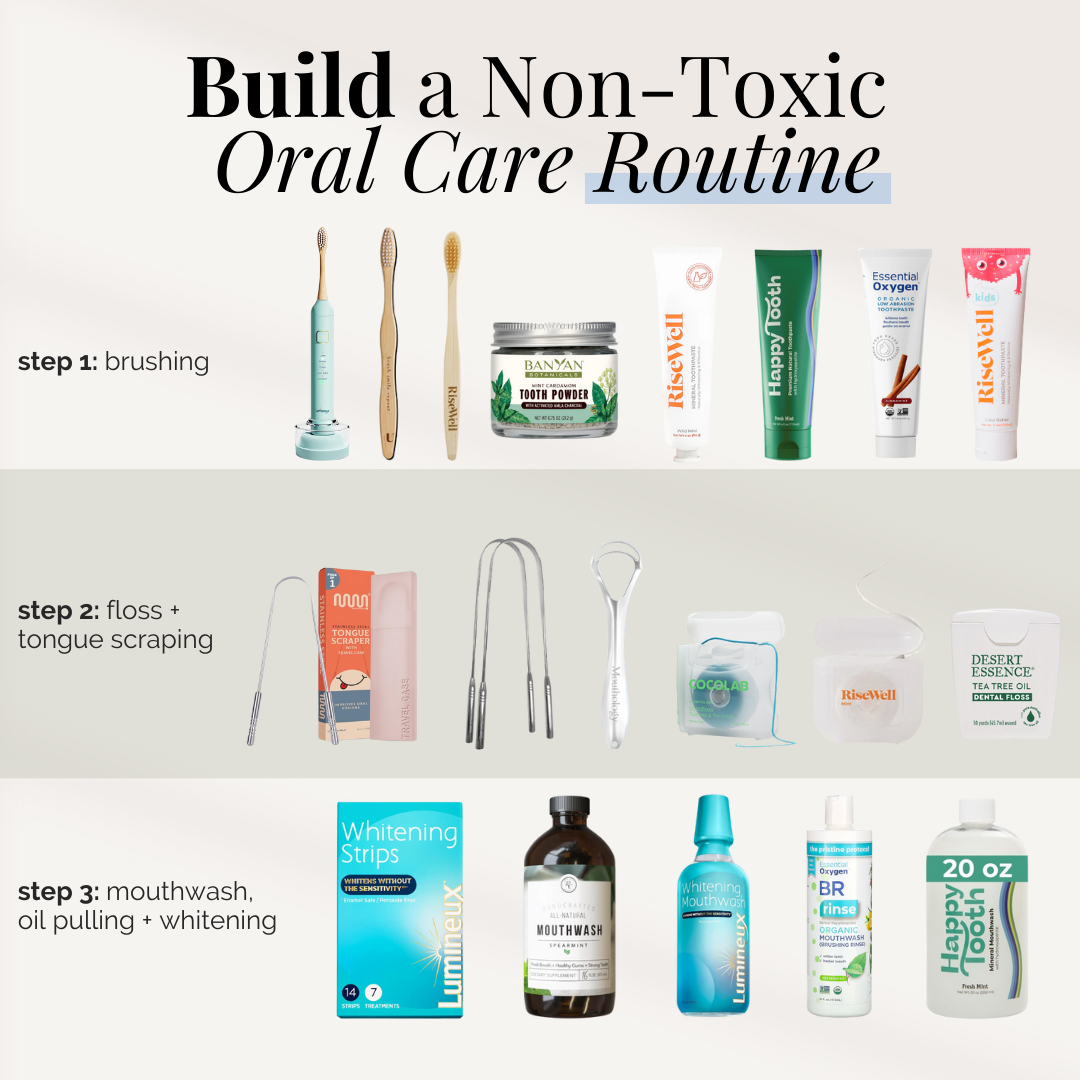
- Start with toothpaste. It’s your highest-impact daily product and directly affects your oral microbiome. Look for hydroxyapatite toothpaste instead of fluoride when possible.
- Upgrade floss next. Avoid PFAS-coated floss and plastic-heavy materials and use silk, bamboo, or other plant-based flosses instead.
- Use mouthwash only if it supports your microbiome. Choose alcohol-free formulas and avoid “kills 99.9% of germs” marketing.
- Whiten gently and less often. Skip harsh chemical strips and focus on enamel-friendly options.
- Add tongue scraping. It takes 10 seconds and helps reduce bacteria load fast.
- Replace products as you run out. You don’t need to overhaul your oral care routine all at once. No dramatic purges. No wasted half-used bottles.
- Swap sooner only if something is irritating you. Gum sensitivity, burning, dryness, or canker sores are indicators to move that product to the top of your list.
- Keep it sustainable. The best routine is the one you’ll actually do every day and that supports your gums, teeth, and overall wellness long-term.
Even More Of Our Favorite Non-Toxic Oral Care Swaps
Below are more of our favorite oral care swaps across all categories to help you select effective non-toxic products for your routine. If you’re ever unsure about a product not in our database, use our Ingredient Glossary to better understand what it contains. Remember, this should be fun! If you’re ever feeling stressed or overwhelmed, take a step back. This guide will always be here for you to reference as you create an oral care routine that leaves your mouth fresher and your teeth brighter than before.
Non-Toxic Whiteners + Tongue Scrapers
Shop our Oral Care Product Marketplace for all our GWE-approved favorites, from toothpaste and floss to mouthwash and tongue scrapers.